Your Agents. Your Infrastructure.
One Binary. Full Sovereignty.
Open-source AI agent runtime. One Go binary, zero dependencies, full control.
$ hector serve
$ hector serve
PS> hector serve



Self-Sovereign AI. No Strings Attached.
Every byte stays on your machines. Every standard is open. Every line is auditable.
- Single Binary. Zero Dependencies. One ~30MB Go executable. No interpreters, no virtualenvs, no package managers. Copy to a server and run. Works out of the box.
- On-Premise & Air-Gapped Deploy in your data center, behind your firewall, with no outbound calls. Your data never touches third-party infra.
- Zero Vendor Lock-In MIT licensed. Open standards only (A2A, MCP). Swap LLM providers with one line. No proprietary SDKs. No telemetry.
Run Ollama for fully local inference, or connect to Anthropic, OpenAI, or Gemini. The choice is yours and you can change it anytime. Guardrails, PII redaction, JWT auth, and tool sandboxing are all built in and declarative.
A2A-Native Federation
Hector is built on the Agent-to-Agent (A2A) protocol. Unlike traditional systems with central orchestrators, Hector enables true peer-to-peer federation.
Agents communicate directly, forming federated networks where each agent maintains autonomy while collaborating seamlessly. Hector is proudly listed as an A2A Compatible Framework.
RAG Ready
Hector comes RAG-ready out of the box. Connect SQL databases, APIs, and document stores to build comprehensive knowledge bases.
Choose from Ollama, OpenAI, or Cohere embedders to convert your data into vectors, automatically indexed into vector databases like Qdrant. Agents retrieve relevant context using semantic search, augmenting their responses with accurate, context-aware answers.
Meet Hector Studio
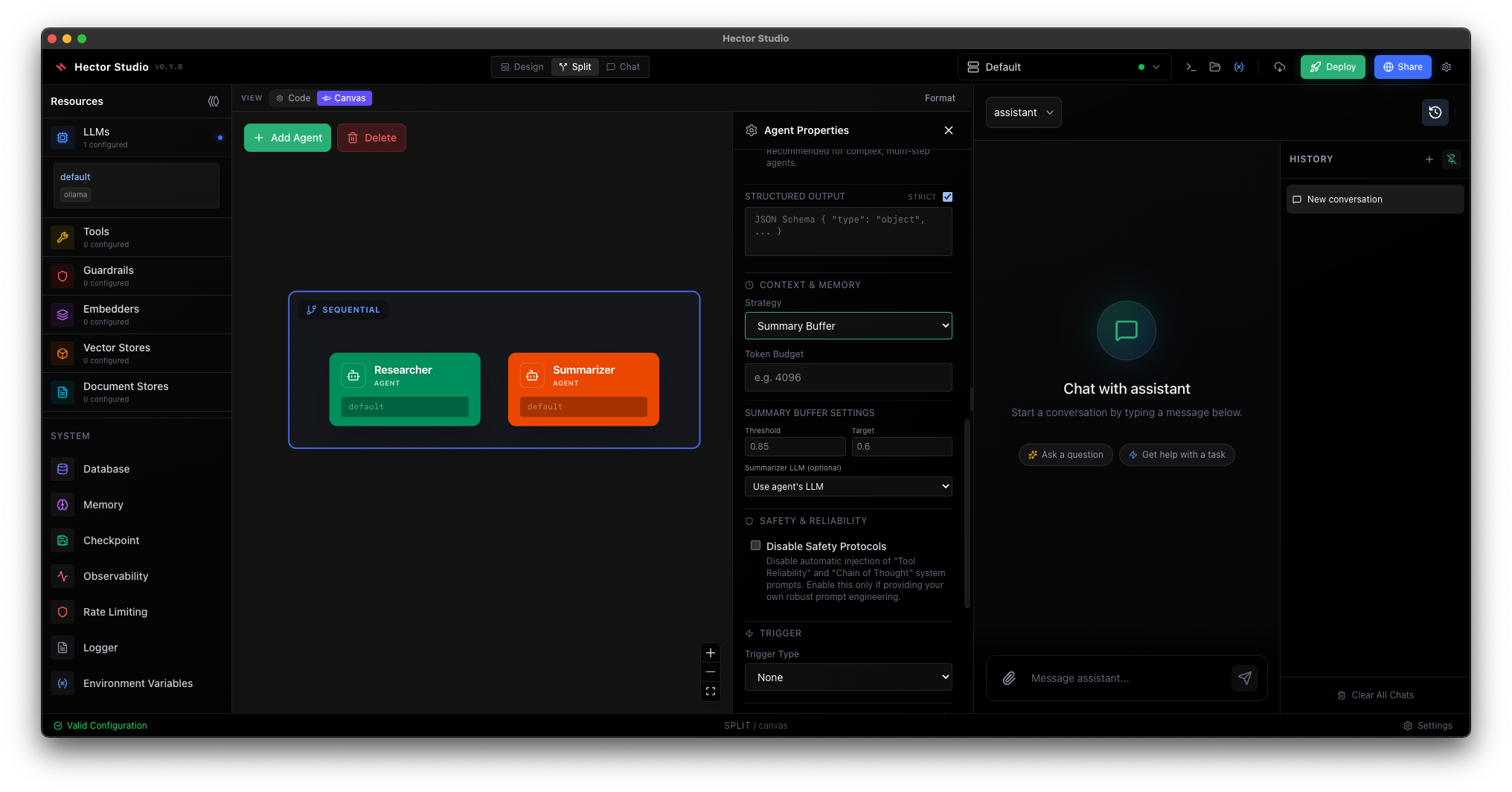
Hector Studio is your visual command center to design, try, and deploy agents with confidence. Whether connecting to a remote production mesh or managing local workspaces, it provides a powerful X-ray view into your system, allowing you to debug message flows, inspect tool executions, and orchestrate complex workflows in real-time.
Programmatic API
Need full control? Hector's programmatic API allows you to build agents, define tools, and orchestrate complex workflows entirely in Go.
Seamlessly mix configuration and code. Embed Hector directly into your applications with a clean, fluent interface.
import "github.com/verikod/hector/pkg/builder"

func main() {
    // 1. Build LLM
    llm := builder.NewLLM("openai").
        APIKey(os.Getenv("OPENAI_API_KEY")).
        MustBuild()

    // 2. Build Agent
    agent, _ := builder.NewAgent("assistant").
        WithLLM(llm).
        WithInstruction("You are a helpful assistant.").
        Build()

    // 3. Run
    runner, _ := builder.NewRunner("app").WithAgent(agent).Build()
    runner.Run(ctx, "user", "session", input, ...)
}
Features
-
 Zero-Code Configuration
Pure YAML agent definition. Define sophisticated agents declaratively and version-control your entire platform. Reviewable in CI, auditable by compliance.
-
 Metrics & Tracing
Built-in Prometheus metrics and OpenTelemetry tracing. Monitor latency, token usage, and errors. All self-hosted, all on your infrastructure.
-
 Guardrails & Security
Prompt injection detection, PII redaction, tool authorization, JWT auth, and command sandboxing. Privacy built in, not bolted on.
-
 Hot Reload
Update configurations instantly. Changes are detected and applied with zero downtime for rapid iteration.
-
Visual UI for designing agents, managing resources, and chatting. Embedded in Hector at http://localhost:8080/.
-
 Multi-Agent
Design complex, multi-step agent behaviors with loops, conditionals, and sub-agent orchestration.
-
 A2A and MCP: Open Standards Only
No proprietary protocols. A2A for agent federation, MCP for tool connectivity. Interoperate with any compliant system.
-
 Single Binary, Zero Dependencies
One ~30MB Go executable. No interpreters, no virtualenvs, no package managers. Deploy on-premise, air-gapped, or in any cloud.
-
 Scalable RAG
Turn any folder, database, or API into a knowledge base with automated chunking, embedding, and vector search. All running on your infrastructure.
